What are “Groups” and why might you care?
The AKC has seven breed groups into which breeds are categorized. The Groups are extremely important for conformation showing but have pretty limited application to anything else. Entry into some Performance events like Hunting and Retrieving or EarthDog or Herding are often restricted but typically by breed rather than by Group.
These are the seven groups:
- Sporting
- Hound
- Working
- Terrier
- Toy
- Non-Sporting
- Herding
In addition, there are the Miscellaneous and FSS (Foundation Stock Service) Groups. “Miscellaneous” is a holding space for breeds that are working toward full AKC recognition. FSS is a stud book service in which the AKC takes charge of tracking the litter registrations. FSS breeds are often also working toward recognition and will usually eventually move into Miscellaneous or even directly into a Breed group.
We don’t routinely report by Group but it can be interesting to do so, occasionally, an easy way to categorize when looking at “little dogs,” like those in the Toy Group, or even making arguments about whether the purpose for which purpose-bred dogs makes a difference in nosework success.
So what’s the problem?
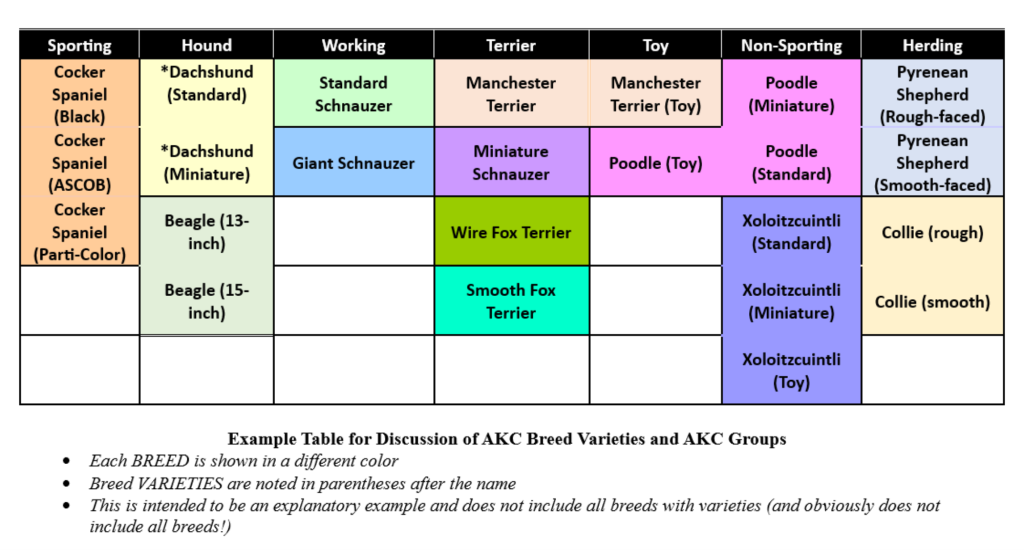
When we debuted our first pdf-formatted reports under the name of Demo Dog Database on February 29, 2024, we did not provide any reporting by AKC Group but DID attempt to assign each breed to a group “just in case.” This was when we first encountered the conundrum that occurs because some breeds are actually split between two groups — the Manchester Terrier and the Poodle, to be specific. In each case, the Toy Variety is in the Toy Group, but the larger Variety(ies) are in a different Group – The Manchester Terrier is in the Terrier Group and the Miniature Poodle and Standard Poodle are in the Non-Sporting Group.. This is in contrast to dogs like the various sizes of Schnauzers, each of which is a different Breed — Miniature Schnauzer, Standard Schnauzer or Giant Schnauzer. This image may make it easier to visualize the situation:
With Demo Dog Database, we initially tried to report not just by breed but by breed Variety — I wanted to know how many Standard Poodles had earned the Scent Work Master Title! The Beagle and Dachshund handlers were the first to protest. They could not understand why we would divide their breed by Variety and wanted the Varieties to be combined. I was a little surprised that the Miniature Dachshund people really wanted their dogs included with the Standard dogs, but it was a good thing they felt that way — and I was out of luck with reporting Poodles by variety. Here’s why:
the AKC’s database records a BREED for every dog, using “All American” to register mixed breeds. For breeds with Varieties, however, NO VARIETY IS RECORDED UPON REGISTRATION. Color is recorded for every dog, so some people may think a dog’s VARIETY has been recorded (a Cocker Spaniel, for example), when, in reality, it is just the color.
I wish I could tell you the exact circumstances under which Variety is finally recorded. I know that Variety is recorded if the dog is involved in any form of AKC Conformation, including “Beginner Puppy” classes which do not count toward Championship. But there may be other conditions when Variety is recorded.
Here are circumstances that we know do NOT cause Variety to be recorded:
- Variety of Sire and Dam. Puppies from a litter of Poodles that is born to parents in the Registry as Standard Poodles will be recorded as Poodles. In fact, “oversize” Toy Poodles that are shown in conformation are registered as having the Variety of Miniature, despite having two Toy parents.
- Being measured for a competition type other than conformation, such as Agility. From Agility results, you can most likely (but not always!) tell the size of a dog by what heights they jump. But that does not cause a Variety to be registered.
- You writing your dog’s Variety on your Scent Work (or other sport) entry form in the provided space. The trial secretary may collect this information and it may print on the trial results you see posted and even be submitted to the AKC with those results. However, the official published AKC Results will show only what is already in the registry for your dog.
And that’s why we can’t separate Varieties out for reporting, no matter how much we want to.
What does that mean for reporting by Group?
Possibly the more interesting question is “then how does the AKC report titles by breed within Group in their Annual Statistics?” And the answer appears to be that they don’t, really. As we saw from the table above, the only two breeds (so far) where this makes any difference is in Poodles and Manchester Terriers. Here is a sample of what the AKC published, showing the number of Toy Poodles achieving some of the lower level titles in 2025:
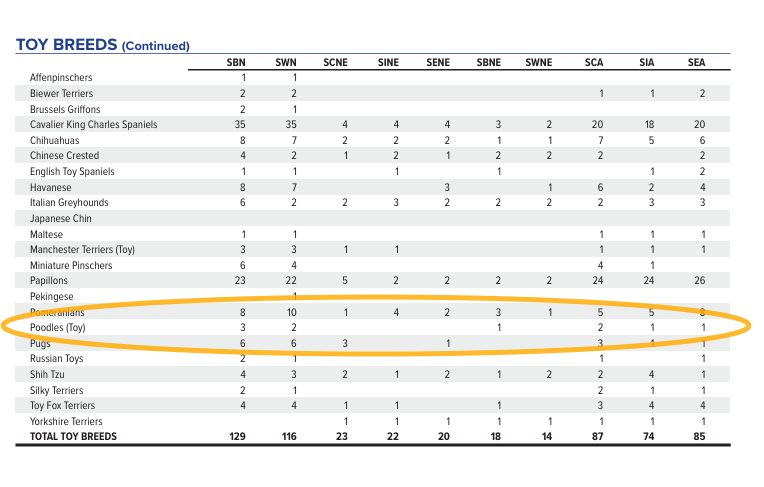
I can confirm that these are the numbers of Poodles who are registered with the “Toy” Variety that earned those titles in 2025. However, it doesn’t account for many others that are registered without a Variety because they have never participated in conformation to have a Variety assigned, and, of course, it doesn’t account for an “PAL” (Purebred Alternative Listing) Poodles who will never have a Variety assigned. And I know several Poodles whose handlers would assure you they are Toys that earned those titles in 2025 but that are registered only as Poodles and are not included in those numbers. This same situation is undoubtedly true with the Manchester Terriers (Toy), so numbers for the Toy group — not just in Scent Work but in ALL sports other than conformation — will always have the potential to be too low in the Annual Statistics.
Couldn’t We Smell Better just let handlers assign the Variety for the dogs?
Well, we could. One problem with that is that we do update the information each time we update results for a dog, which, if we were tracking Variety, would be desirable as the dog might have acquired a Variety through participation in conformation, for example. So we’d need to set some kind of flag to make sure we didn’t overwrite it with the ‘generic’ breed from the AKC.
But the bigger issue is that we know not everyone would (or could) do this, and, as a result, we would never have any real data integrity for reporting by Variety.
So does We Smell Better report by Group?
Not routinely, but we do sometimes, usually for one-off queries that we explore here on the Blog. And, when we do, we will just always have to make the caveat that the Toy group may be missing some Poodles and Manchester Terriers and the Terrier and Non-Sporting Groups may have some extra.